About
Drums
by John Roberts
When
we say we are “tuning” a drum, what does that really
mean? With the exception of kettledrums and tympani,
drums do not make single identifiable notes when
played. Drums actually make several different notes
simultaneously.
What
we call “tuning” mainly consists of several steps. 1)
voicing the batter head tension for the initial lug
note sounded when struck. 2) voicing the resonant head
for agreeable after-ring decay after the drum strike.
3) clearing the lugs to perfectly agree with each
other. This third step is the secret sauce that makes
the difference between a drum that measures like it
should be in tune, and one that sounds like it is in
tune.
Even
if a note sniffer says every lug is voicing the same
lug resonance, they can still disagree at higher
overtones. When a drum sounds multiple closely spaced
higher overtones they interfere against each other and
create dissonance. When those higher overtones are
also in tune the result is a simpler, cleaner drum
sound without the harsh dissonance.
The
Physics of Overtones
Typical
musical instruments play only one note at a time, one
note per guitar string or one note per piano key.
These notes can contain multiple higher frequency
harmonics that define their complete sound character.
These overtones generally fall on perfect harmonic
ratios due to how these musical sounds are created.
Even though they are different frequencies, they all
combine to sound like a single musical note with
complex sound character.
In a musical instrument
that vibrates a string under tension, or a wind
instrument that vibrates a column of air, the
wavelength of the sound generated is defined by a
physical dimension like the length of the string or
length of the air column. Wavelength, just like the
word sounds, is the length of a single waveform,
beginning at zero, looping up before reversing to pass
down through zero to loop below then return back up to
zero again to start over. These zero points in the
wavelength are called nodes, and these points of zero
movement line up with hard physical boundaries. The
endpoints of a string where it is firmly attached or
the closed end of an organ pipe form natural nodes.
The open end of an organ pipe is where the natural
anti-node (peak amplitude) occurs so that length is
for a 1/4 wavelength. String length and drumhead
dimension nodes define full or 1/2 wavelengths.
The frequency or pitch
of the fundamental note is determined by how fast
sound travels in the vibrating medium and how far that
sound must travel. The “period” of a waveform is the
time it takes to form one complete wavelength. The
frequency or pitch of this waveform is the
mathematical reciprocal of this period or 1/period. To
make different pitch notes in a pipe organ you use
different length pipes. When playing a guitar you can
make the effective length of the vibrating string
shorter and therefore shift the note pitch up higher
by pressing the string hard against a fret to form a
new end point or node there. The shorter the length of
vibrating string, the higher the note pitch it makes.
The multiple guitar strings on one guitar are made
using different diameter (weight) wire, so when
the same length, they make a musically useful ratio or
spread of notes. String tension is also varied to
fine tune the actual notes.
An important difference
about how higher pitch overtones develop in these
conventional musical instruments, as compared to
drums, is that conventional musical instrument
overtones travel over the exact same physical path as
the fundamental note. Since the overtone wavelength
nodes must line up at the same physical boundaries,
the overtones only meet these criteria for full
multiples, like 2, 3, or N complete wavelengths
fitting neatly into the same fundamental wavelength
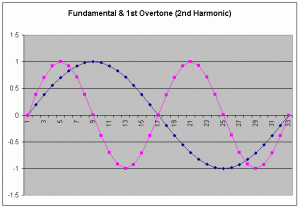
path. Doubles of the fundamental pitch make harmonic
overtones that fall on the same musical notes but in
higher octaves (2nd, 4th, 8th etc).
The Physics of
Overtones in Drums
Unlike conventional
musical instruments where the sound energy vibration
is limited to a one-dimensional path, sound vibrations
in a drumhead can travel anywhere within a round
two-dimensional space. The distance straight across
the drumhead defines one wavelength series. A round
zero movement node is established by the fixed
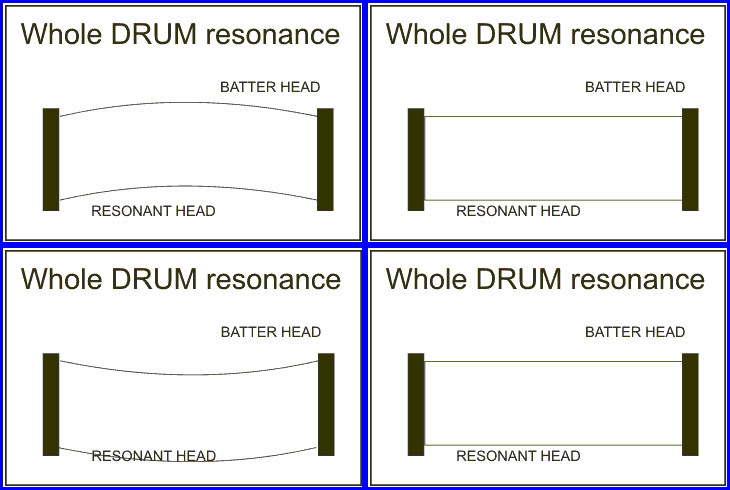
rim-edge drumhead attachment. As we can see in the far
left hand animation below viewing a drumhead vibrating
at the fundamental resonance, from the side looks like
one half of a sine wave, with alternating up and down
motion.
Loudspeaker diaphragms
generally move in and out as a single rigid surface
operating in what is called “piston motion”. When a
loudspeaker driver diaphragm starts vibrating across
it’s diameter like a drumhead, making higher frequency
overtones, these are called “break-up” modes and
undesirable. When drumheads do this it’s just normal
drum behavior.
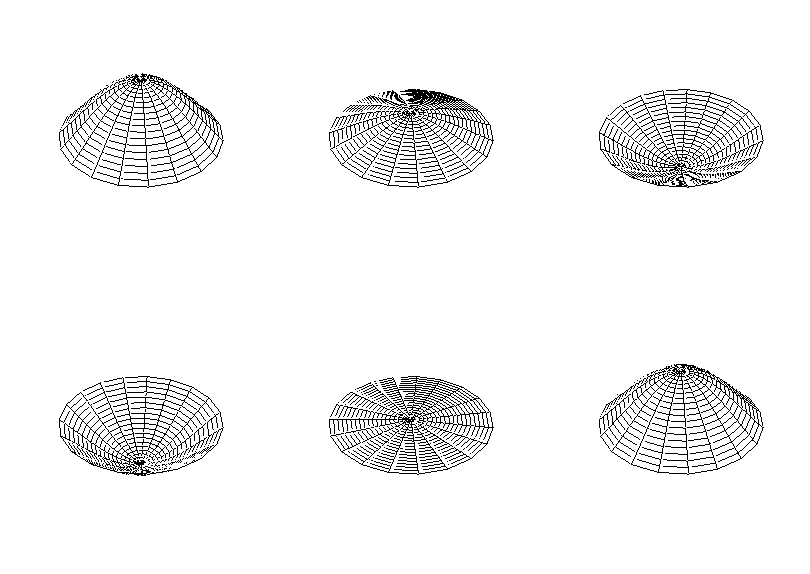
Fundamental mode
(0,1) 1x This is the lowest
frequency resonance that drums vibrate in.
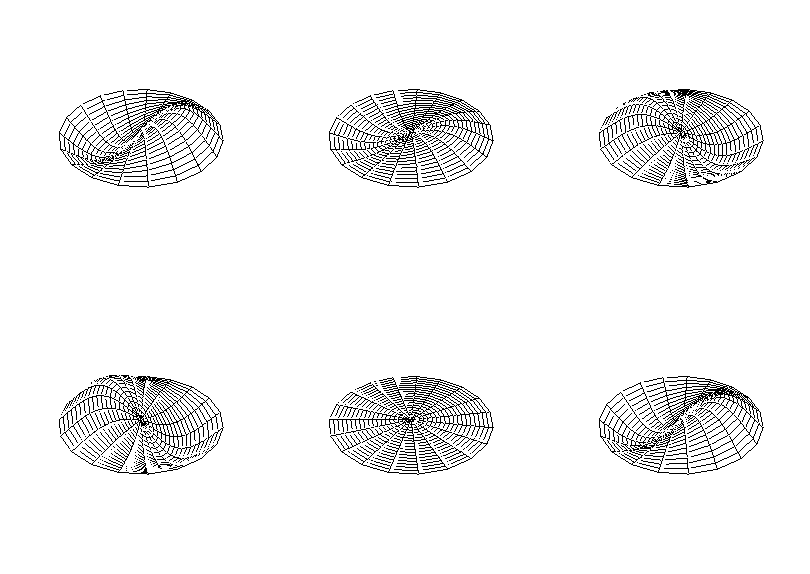
Lug mode (1,1)
1.593x fundamental This is the next
higher resonance above the fundamental that drums
vibrate in. This resonance is the one used for matching
lug pitch in various tuning strategies.
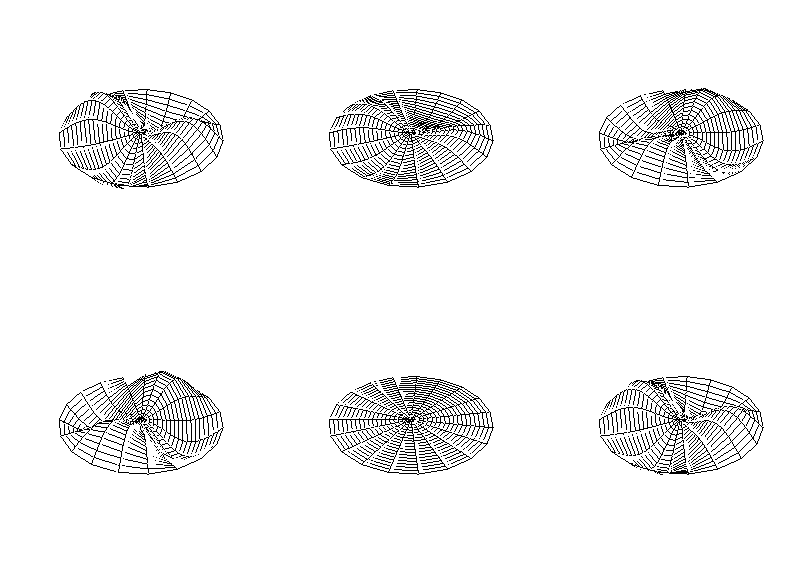
Lug mode (2,1)
2.135x fundamental This is the next
higher resonance above Lug mode. For one headed concert
toms mode (1,1) is suppressed and this is the
dominant Lug mode used for tuning.
The wavelength for other
series of resonances traces circular paths around and
across the middle of the drumhead. Since the
circumference or distance around a circle is “pi” (3.14)
times the distance across the same circle, there are
multiple different non-integer ratios between the drum
fundamental pitch and higher pitched drumhead overtones.
These non-integer ratios cause drumhead overtones to
fall on different notes. Vibration mode 1,1 and 2,1 have
a fixed node at the midpoint and additional nodes and
anti-nodes that fall on a circle mid-way between the
center point and rim edge. Other vibration series fall
on other smaller circles, and one higher overtone series
has an anti-node (peak) dead center again, similar to
the lowest fundamental.
When only one head
is mounted, like on a “concert tom”, mode (1,1) is weak
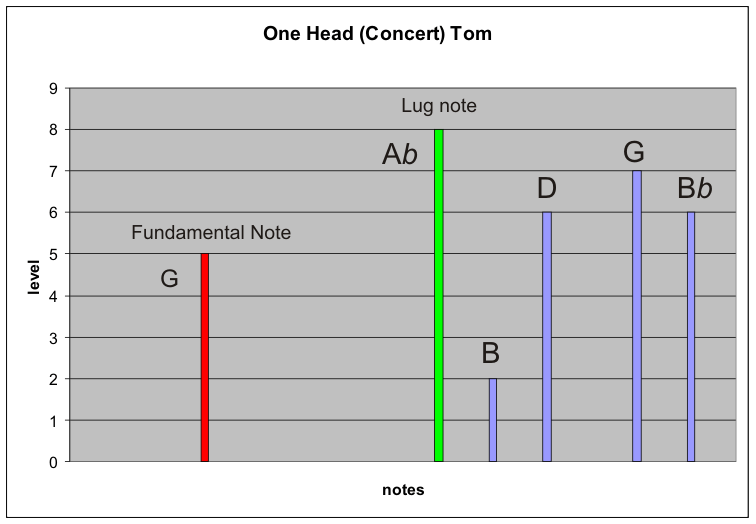
and mode (2,1) dominates the first overtone. The chart
below shows a series of typical notes and levels with
the fundamental (in red), first overtone (in green), and
higher resonances (in blue). These readings were
made using a RESOTUNE II to excite the drumhead with
sound energy from it’s internal loudspeakers. Resonances
excited by drumstick hits will preferentially excite the
resonances louder that have anti-nodes (local maximums)
directly under where the drumhead is hit. For example
the fundamental note is most excited by striking the
drumhead dead center where it has the largest up/down
movement or excursion. Higher pitch resonances generally
have peak activity away from the drumhead center point,
so respond more when the head is struck off-center.
Hitting even closer to the rim edge excites even higher
pitched overtones.
Observe that these notes
are not on useful musical intervals and do not make some
euphonious drum chord. Instead they are a characteristic
mix of different notes that drummers can play louder or
softer selectively by how and where they strike the
drumhead. The concert tom is preferred by some drummers
for it’s characteristic sound. With only one head, the
sound is also more repeatable than from using two headed
drums because there isn’t a second different tensioned
head interacting with the first head differently at
different resonances. All concert toms will exhibit the
same characteristic ratio between notes, while two
headed drums will vary more with voicing.
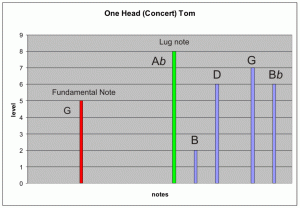
The most important sound
characteristic of a one-headed or concert tom is the
spacing between the lowest note fundamental and the
first (lug) overtone. The span between G and Ab is
musically just the next note higher but in reality it is
over one full octave higher. If we look at the standard
vibration modes for a round flat vibrating disc we see
this spacing agrees with the lug overtone being
vibration mode (2,1) at 2.135x above the fundamental.
Vibration mode (1,1) falls in the middle between them at
1.593x, but is not active in concert toms. That
vibration mode apparently needs the bottom head to
support a strong resonance. When we tension a one headed
drum tighter, this increases the speed of sound
traveling across and around the drumhead, like
tightening a guitar string, so all the note pitches
shift up higher together, while maintaining the same
ratio between resonances and makes the same
characteristic sound just at higher pitch.
If one head is good two
must be better?
We are most familiar with
two headed drums. Adding a second head to the system
doubles the vibrating mass since the two heads will both
vibrate together for some resonances even though only
the batter head is the one being hit. This extra
vibrating mass sustains longer after being hit. There
are multiple mechanical and acoustic pathways between
these two heads to transfer energy back and forth. The
most obvious is the air path coupling the two heads
together. Another path for sound energy transfer is to
mechanically couple vibration from the batter head
through the rim into the shell, through the shell down
into the bottom rim and into the resonant head. These
different pathways will exhibit different transit times,
different coupling efficiency, and even resonances of
their own. Coupling between the heads can be
constructive, destructive, or neither for different
pitch head resonances. If a drum shell’s natural
resonant pitch agrees with one or both drumhead
resonances, the coupling between them at that resonance
could be enhanced. In practice most shells have so much
hardware bolted to them that any natural free vibration
mode will not be very pure, while simple mechanical
sound transmission will clearly occur. Investigating the
full effects of shell interaction is beyond this general
overview of tuning and the shells are not adjustable
anyhow. Drums made with different shell depth and from
different shell materials will behave and sound
different.
One relatively simple
mechanism to inspect is the acoustic coupling directly
through the air path between the two heads. When the top
batter head is struck dead center, it bows inward and
compresses the air inside the drum. This momentary
pressure increase pushes down on the bottom resonant
head, moving it down in the same direction. As the top
head swings back up, due to the restoring force of it’s
spring compliance, it generates a reduced internal
pressure, sucking the bottom head up with it. At the
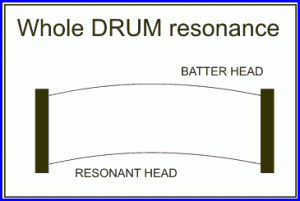
fundamental (lowest) note resonance, these two heads
move up and down together as a single connected system.
The mass and tension of both heads influence the pitch
of this combination fundamental note. Changing the
tension of the bottom head will shift the fundamental
pitch of the top head because they both vibrate
together. In theory there is a resonance mode where
these two heads move in the exact opposite direction
from each other, but this mode, dissipates energy
quickly from squeezing and stretching the air inside the
drum, so should decay quickly. It could be supported by
a shell resonance wavelength that has a node at one rim
edge and anti-node at the other rim edge of the shell.
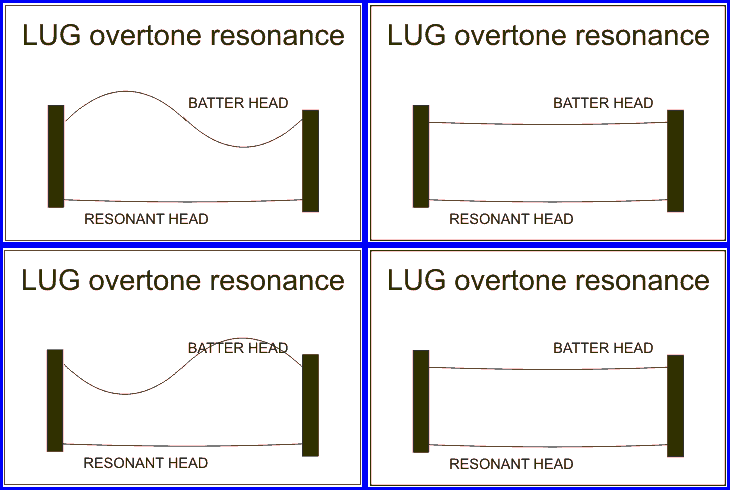
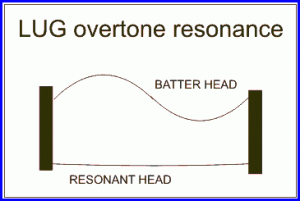
Many of the higher
overtone series do not compress the air inside the drum
between the two heads, because after the initial pulse,
a standing wave forms in the drumhead that causes one
half of the drumhead to be moving up whenever the other
half is moving down, and vice versa. When one half of
the batter head is always going up at the same time as
the other half of the head is going down, the air inside
the drum is not being squeezed and less sound energy
couples through this pathway to the opposite head. The
initial pulse, before the standing wave builds up, will
cause some direct energy transfer to the opposite head.
The impact of this depends on how the top and bottom
head resonances are set relative to each other. Unlike
the fundamental resonance that involves both heads, the
lug overtone and most higher overtones are local to just
each head independently. If the two heads are tensioned
precisely alike, this pulse from a strong hit will
excite the resonant head sympathetically. If the two
heads are tensioned differently, or have different mass,
causing a different resonance pitch, the sympathetic
resonance is less pronounced.
Many of the higher
overtone series do not compress the air inside the drum
between the two heads, because after the initial pulse,
a standing wave forms in the drumhead that causes one
half of the drumhead to be moving up whenever the other
half is moving down, and vice versa. When one half of
the batter head is always going up at the same time as
the other half of the head is going down, the air inside
the drum is not being squeezed and less sound energy
couples through this pathway to the opposite head. The
initial pulse, before the standing wave builds up, will
cause some direct energy transfer to the opposite head.
The impact of this depends on how the top and bottom
head resonances are set relative to each other. Unlike
the fundamental resonance that involves both heads, the
lug overtone and most higher overtones are local to just
each head independently. If the two heads are tensioned
precisely alike, this pulse from a strong hit will
excite the resonant head sympathetically. If the two
heads are tensioned differently, or have different mass,
causing a different resonance pitch, the sympathetic
resonance is less pronounced.
Often the two heads are
intentionally tensioned to slightly different lug
resonances to reduce the amount and duration of sustain.
This can also subtly shift the after-ring. All drums
will experience a slight drop in pitch between the
initial attack and the after-ring, because the head
deflection from the initial high amplitude vibration
transiently increases the head tension shifting the
pitch up. As this amplitude drops and the tension
relaxes, the pitch glides lower.
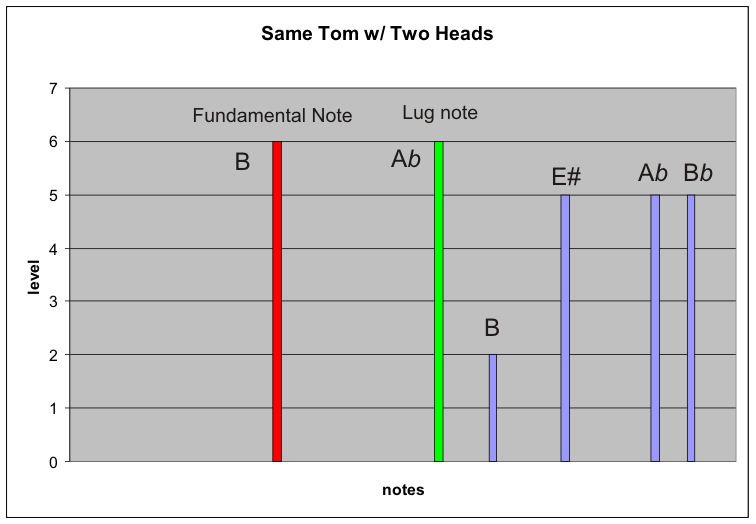
If we re-inspect the
resonances in that exact same tom batter head as
measured above, but this time with a similar weight
resonant head mounted to the bottom of the shell, and
tensioned to the same lug resonance note pitch, we see
an interesting change. The top head lug resonance
remains the same note pitch, as before, since that head
tension has not changed, but now the fundamental note
pitch has been pulled up to a higher note pitch. It is
not immediately obvious that the higher mass of two
heads vibrating together would vibrate faster, but this
is not a simple relationship.
Resonance in any
mechanical system is characterized as the conversion
back and forth between the kinetic energy of the
drumhead mass moving up and down into the potential
energy of a spring stretching and relaxing. The head
stretching is this spring. The frequency of such
resonances is influenced by one divided by 2 pi times
the square root of the ratio between this spring rate
divided by the mass. The head mass for a two head
drum is a simple double, and now even the air mass
captured between the two heads adds to and becomes part
of the combined system increasing the vibrating mass,
but there are now two springs or edge compliances
between the head and rim system in parallel. The
effective spring rate for two same size heads in
parallel is stiffer than one proportionately larger head
and the resonant note reflects that by being a higher
pitch.
The note spacing now
between fundamental and lug overtones are consistent
with disc vibration mode (1,1) or 1.593x. Instead
of the fundamental being the same and all the higher
resonances shifting, the lug resonance stays the same as
before and the fundamental note shifts up.
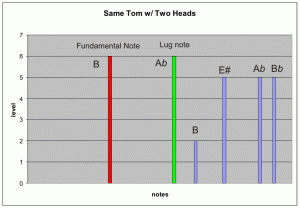
This tighter spacing
between fundamental and lug overtone is the first
significant difference between using one head and two,
but there is another important difference. The ratio
between lug overtone and fundamental is no longer
rigidly fixed to follow a hard ratio based on the head
dimension, but the relative mass and tension of the two
heads can now shift the fundamental and associated
resonances up or down, relative to the other resonance
series. We now have a much wider palate of voicing
possibilities defined by the relative tension and weight
of the two heads.
For similar weight heads,
you can completely characterize the voicing of a
two-headed drum by measuring the top and bottom head lug
resonance notes. Noting these two Lug notes (and head
weights) will allow you to always return to a favorite
drum voicing. By replicating these Lug notes and heads
used, you can make different drums sound more alike (if
desired), while mechanical characteristics of the shell
and hardware between different drums can affect the
higher resonances subtly.
We do not believe that
there is only one ideal voicing for all drums so decline
to give specific voicing advice. We observe that it is
popular to de-tune the bottom resonant head slightly
higher or slightly lower pitch than the batter head lug
note, but even this is not universal. Here is a link to
one pretty comprehensive general discussion of tuning
and voicing drums Prof sound-Drum
tuning bible .
We are inclined to downplay any tuning advice that
argues that there is only one way to voice a drum that
sounds good. There are multiple different opinions
published. We suggest that you try them all and take
time to experiment and find your own personal
voice.
If drum tuning is not
just about note pitch what is it about?
Now we come to the major
source of confusion surrounding this topic. Why can
drums be adjusted to make the same note pitch at a given
resonance, but exhibit such different sound
quality? The attachment method of using multiple
lugs spaced around the drumhead circumference to tension
the drumhead can cause very audible sound quality
differences when the lug tensions are not very closely
matched to each other. The fundamental note pitch tracks
with the average head tension so half of the lugs could
be too tight and the other half too loose while still
making the same fundamental note pitch. However as we
inspect the behavior at higher vibration modes we find
progressively more significance attached to individual
lug tension and the matching between these lugs. These
slight tension differences along with tiny mechanical
imperfections in the drum construction can cause
significant audible differences.
If the lugs are not in
perfect agreement with each other, instead of just
making the lowest possible number of overtone notes,
sounding pure when played, we hear instead a much more
complex dissonant sound character from multiple closely
spaced overtones. This state of perfect tune when all
the lugs are in complete agreement with each other is
called “clear” or “clearing” the head, because the sound
character of the drum appears to open up, or clean up,
sounding more pure, or as pure as it can possibly sound
from that mix of non-related drum notes.
________________________________
Unusual or special drums
The Bass/Kick drum:
is generally just a larger tom, laying on it’s side. One
import distinction about Kick drum sound is related to
how it is struck. The fixed foot pedal beater strikes
the drumhead dead center. That preferentially excites
the fundamental resonance. As we recall from the concert
tom discussion, when the resonant head is not mounted,
the fundamental note pitch generated is lower frequency,
perhaps desirable for a kick drum.
There are also
after-market products that form a port with a hole in
the kick drum resonant head. Without doing a detailed
analysis of the physic involved, this is probably a
combination of adding mass to the head with some
acoustic effect from the port. I’ll leave it to others
to determine what is really controlling resonances and
note pitch with those.
The Snare drum: is another
variant on the two head tom for dominant head
resonances, but in addition there are wire snares strung
across the resonant head. While these snares do not
vibrate like a musical instrument string, instead they
rattle up against resonant head, but in a musically
pleasing way. The shell of typical snare drums is
shorter than most toms, and far more rigid, often made
of dense metal or sometimes very thick wood. This
increases the mechanical transmission though the shell
from the top batter head down into the resonant end rim
and snares.
The conga drum is a
variant on the one-headed concert tom with similar
resonant series note ratios. In addition the longer
shell forms a tuned resonant air column, like a very
short organ pipe, or a long loudspeaker port. This extra
acoustic structure can enhance a lower note resonance.
The tympani and kettledrum
are special cases of one headed drums designed for
orchestral use that are perceived as making single note
pitches when played. Their sealed back air cavity
suppresses resonances like the typical lowest
fundamental mode (0,1), that would compress the internal
captive volume of air. Their sound character is
dominated by vibration modes (1,1), (2,1), (3,1), etc.
where half the drum head area is moving up while the
other half is moving down so don’t increase
or decrease the internal air pressure.
The tympani/kettle drum is
designed so that these lower resonances fall on a pitch
spacing that while not perfect harmonics of each other,
this spacing mimics them being upper harmonics above a
missing lower phantom fundamental note. Our brain is
trained to interpret that specific overtone spacing,
based on our experience with naturally occurring musical
sounds. Our brain assumes this missing lower note must
be present, and hears the complex note as if the missing
fundamental was present. This musical psycho-acoustic
trickery allows the tympani/kettle drum to appear to
make notes at lower note pitch than their physical
dimensions can actually support.
Practical issues with
note targeting
Only one major drum
manufacturer, that we are aware of (DW) provides a note
target for their drums. They call this “Timbre-Match”
(r) and identify this as the shell note pitch. From
discussion with DW techs this should be coordinated with
the lug resonance so it can also be targeted while using
tap tuning, or any of the electronic sniffer variants
providing specific pitch information. Timbre-Match (r)
is a registered mark or Drum Workshop, Inc.
Special drumheads and
damping rings
While discussing all of
the head variants is also beyond the scope of this
overview I have some general observations. Many of the
exotic drumhead designs attempt to squelch the higher
overtones to reduce the apparent dissonance of a poorly
cleared drumhead. If the upper overtones are damped you
can’t hear how un-clear they are. Damping also reduces
sustain, if the drumhead doesn’t sound great when you
hit it, why let it sound that way even longer? So my
suspicion is that many of these trick drumheads are
designed to conceal the sound of not being well tuned or
“cleared”.
There is one alternate
head technology with some actual physics behind it. The
“dot” heads have a small mass added right at the center
mid-point of the drumhead. For the vibration modes (like
1,1 and 2,1) where the exact mid-point node is sitting
dead still, this added mass has no effect. However for
the fundamental mode (0,1), this midpoint is now an
anti-node and moving vigorously up and down. As we
should recall from the mass/spring rate discussion, mass
is in the denominator of the natural frequency equation,
so more mass makes a lower note. The goal is to shift
the fundamental note of a two head drum down from the
nominal 1/1.593x, to 1/2x or one full octave spacing a
useful ratio that makes the same note only in a
different octave.
Different weight
top/bottom heads
We still decline to give
specific voicing advice but in general the tension and
mass of a head affects stick feel as well as rate of
sound decay. Using different weight heads on the top and
bottom can make subtle voicing differences similar to
de-tuning. Experiment and try different
combinations, if you like the way some combination
sounds use it. If you don’t like the sound, don’t use
it.
Note spread across toms
Before you lose too much
sleep trying to decide which resonant series to target
to be precisely on note, since they all can’t all be
tuned exactly on full notes, lets look at the popular
practice of establishing a musical spread of note
pitches across your different toms. If all the batter
and resonant heads are the same weight or same ratio of
weights, with similar relative tuning, a musical note
spread of lug resonances will map out directly to the
same note spread of fundamental resonances. While only
one or the other set of resonances can be tuned to fall
precisely on full notes. Don’t lose any sleep over
this. One clue about whether you might favor tuning
the fundamental or lug resonance to be on note, when you
play a run across your toms do you hit them dead center
making the “thud” fundamental sound, or do you hit them
off center exciting more of the lug overtone ring? Again
do not lose one moment of sleep over this.
Conclusion
A well-tuned drum kit that
sounds great is more fun to play and sounds better to
everybody else too. If a drum is worth playing it is
worth tuning as well as you can. Despite writing far too
much about specific notes, the perceived sound quality
of a drum kit is most influenced by clear quality, and
how pure it sounds, Not making just one of the several
different notes fall precisely on some note target.
Adjust the lug tension so it feels good when you hit it.
Clear the lugs to each other so the head is only making
the smallest number of different notes instead of a
complex dissonant mess, and enjoy yourself. Even if you
don’t have access to the latest technology, do the best
job you can using whatever tools you have available
(even if just your ears and a well placed finger). We
hope this information is helpful.
Reading for extra credit
The math and physics
describing these resonances is beyond our basic
discussion but for more information on drumhead physics
see Acoustics and Vibration Animations – Dan
Russell, Kettering University
I also highly recommend
the book “Science of Percussion Instruments” by
Thomas D. Rossing for a broad technical discussion of
several different types of percussion instruments.
A link describing old
school “tap-tuning” ,
by an old friend Steve Volpp who knows a little about
drums.
A link to lots of general
information about tuning and voicing drums. Prof sound
Glossary:
Note frequency in Hz over
several octaves re: A=440
| B |
493.9 |
246.9 |
123.5 |
61.7 |
30.9 |
| Bb |
466.2 |
233.1 |
116.5 |
58.3 |
29.1 |
| A |
440.0 |
220.0 |
110.0 |
55.0 |
27.5 |
| Ab |
415.3 |
207.7 |
103.8 |
51.9 |
26.0 |
| G |
392.0 |
196.0 |
98.0 |
49.0 |
24.5 |
| F# |
370.0 |
185.0 |
92.5 |
46.2 |
23.1 |
| F |
349.2 |
174.6 |
87.3 |
43.7 |
21.8 |
| E |
329.6 |
164.8 |
82.4 |
41.2 |
20.6 |
| Eb |
311.1 |
155.6 |
77.8 |
38.9 |
19.4 |
| D |
293.7 |
146.8 |
73.4 |
36.7 |
18.4 |
| C# |
277.2 |
138.6 |
69.3 |
34.6 |
17.3 |
| C |
261.6 |
130.8 |
65.4 |
32.7 |
16.4 |
click
for note to Hz table with 25 cent resolution
Batter Head:
This is the top head for toms or snare, and the head on
the bass/kick drum closest to you that you strike with
the beater. The batter head is the one you hit, makes
the loudest sound, and has the most influence on your
sound quality. Since it is the one you are constantly
hitting, it is also the one most likely to drift out of
adjustment from playing so needs more re-tuning and
re-clearing attention.
Resonant Head: This
is the bottom head for toms, and front head on bass/kick
drums. The one you don’t hit. As the name suggests this
head mostly vibrates sympathetically with the batter
head to shape the total sound envelope including sustain
and decay after the batter head is struck. These should
be cleared when changed, but generally do not require as
much touch up as the head being hit. Concert toms
do not use a resonant head, and many kick drums have
holes (for microphones) in the resonant
head.
Sharp (pitch):
This describes a higher note pitch or tighter lug
tension.
Flat (pitch):
This refers to a lower note pitch or looser lug tension.
Clear: This
describes the state of agreement between the multiple
lug tensions on a given drumhead. When all of the lugs
are precisely matched to apply the exact same influence
on the drumhead standing waves, the drumhead will make a
single set of resonant notes. This single set of
resonances will sound more “pure” and “open sounding”
compared to the same drumhead that isn’t clear. Clear
quality is different from note pitch targeting and a
drumhead can be cleared for any arbitrary
pitch.
Resonance :
In mechanical systems with moving mass and spring
compliances, the efficient transfer back and forth of
kinetic energy between the movement of the mass into the
potential energy of a coiled spring and back again can
express as a sustained natural frequency, only
diminished by damping that dissipates the energy and
causes the sound to decay. Drumhead/ drum systems can
express multiple resonances.
Voicing: this
describes the subjective personal selection of head
weights, absolute and relative lug tension or resonance
target pitches between both heads to realize a desired
overall sound character. This is mainly a consideration
for two-head drums because one head drums like concert
toms have fixed resonance ratios, so can only be tuned
higher or lower as a group, not relative to each other.
|